
-->
- Nuget Gallery Visual Studio Code
- Vs Code Nuget Package Manager
- Add Nuget To Visual Studio Code
- Nuget Extension For Visual Studio Code
- Launch from the menu bar View Command Palette or ⇧⌘P (Ctrl+Shift+P on Windows and Linux). Type Nuget: Open Gallery. The GUI above is displayed. You can filter just like in regular Visual Studio. Make sure the.csproj file checkbox is selected, select version from dropdown, and click install button.
- Visual Studio Enterprise 2019 16.9.3 (latest) Unity 2020.3.1f1. I've only installed the 'Game development with Unity' workload in the Visual Studio Installer. I've also set Visual Studio as the external script editor in Unity and i can successfully run the unity project from vs.
The CLI tool allows you to easily update and restore NuGet packages in projects and solutions. This tool provides all NuGet capabilities on Windows, and also provides most features on Mac and Linux when running under Mono.
With Visual Studio 2017 version 15.9 and later, the Azure DevOps credential provider is bundled in Visual Studio. If nuget.exe uses MSBuild from that specific Visual Studio toolset, then the plugin will be discovered automatically. When dotnet.exe needs credentials to authenticate with a feed, it looks for them in the following manner: Look for credentials in NuGet.config files.
The nuget.exe CLI is for your .NET Framework project and non-SDK-style projects (for example, a non-SDK style project that targets .NET Standard libraries). If you are using a non-SDK-style project that has been migrated to PackageReference, use the dotnet CLI instead. The nuget.exe CLI requires a packages.config file for package references.
Note
In most scenarios, we recommend migrating non-SDK-style projects that use packages.config to PackageReference, and then you can use the dotnet CLI instead of the nuget.exe CLI. Migration is not currently available for C++ and ASP.NET projects.
This article shows you basic usage for a few of the most common nuget.exe CLI commands. For most of these commands, the CLI tool looks for a project file in the current directory, unless a project file is specified in the command. For a complete list of commands and the arguments you may use, see the nuget.exe CLI reference.
Prerequisites

- Install the
nuget.exeCLI by downloading it from nuget.org, saving that.exefile to a suitable folder, and adding that folder to your PATH environment variable.
Install a package
The install command downloads and installs a package into a project, defaulting to the current folder, using specified package sources. Install new packages into the packages folder in your project root directory.
Important
The installcommand does not modify a project file or packages.config; in this way it's similar to restore in that it only adds packages to disk but does not change a project's dependencies. To add a dependency, either add a package through the Package Manager UI or Console in Visual Studio, or modify packages.config and then run either install or restore.

Open a command line and switch to the directory that contains your project file.
Use the following command to install a NuGet package to the packages folder.
To install the
Newtonsoft.jsonpackage to the packages folder, use the following command:
Alternatively, you can use the following command to install a NuGet package using an existing packages.config file to the packages folder. This does not add the package to your project dependencies, but installs it locally.
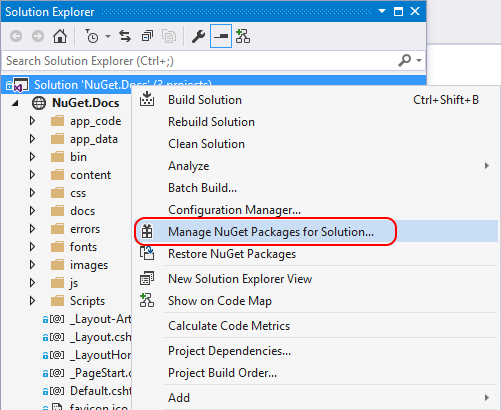
Install a specific version of a package
If the version is not specified when you use the install command, NuGet installs the latest version of the package. You can also install a specific version of a Nuget package:
For example, to add version 12.0.1 of the Newtonsoft.json package, use this command:
For more information on the limitations and behavior of install, see Install a package.
Remove a package
To delete one or more packages, delete the packages you want to remove from the packages folder.
If you want to reinstall packages, use the restore or install command.
List packages
You can display a list of packages from a given source using the list command. Use the -Source option to restrict the search.
For example, list packages in the packages folder.
If you use a search term, the search includes names of packages, tags, and package descriptions.
Update an individual package
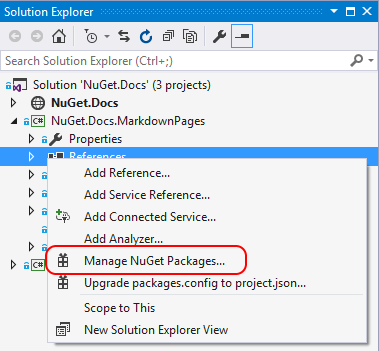
NuGet installs the latest version of the package when you use the install command unless you specify the package version.
Nuget Gallery Visual Studio Code
Update all packages
Use the update command to update all packages. Updates all packages in a project (using packages.config) to their latest available versions. It is recommended to run restore before running update.
Restore packages
Use the restore command, which downloads and installs any packages missing from the packages folder.
For projects migrated to PackageReference, use msbuild -t:restore to restore packages instead.
restore only adds packages to disk but does not change a project's dependencies. To restore project dependencies, modify packages.config, then use the restore command.
Vs Code Nuget Package Manager

As with the other nuget.exe CLI commands, first open a command line and switch to the directory that contains your project file.
To restore a package using restore:
Get the CLI version
Use this command:
Add Nuget To Visual Studio Code
The first line in the help output shows the version. To avoid scrolling up, use nuget help | more instead.
Nuget Extension For Visual Studio Code
An extension for Visual Studio Code that lets you easily add or remove.NET Core 1.1+ package references to/from your project's Features
Adding a Package: Removing a Package: Known Issues
Release Notes1.1.6
1.1.5
1.1.4
1.1.3
1.1.2
1.1.1
1.1.0
1.0.1, 1.0.2
1.0.0
0.1.1
0.1.0
0.0.4
0.0.3
0.0.2
0.0.1-alphaInitial release. |